

I have had some version of the same conversation with a CIO almost every day this year. It usually starts the same way. Their team has read about context layers, or seen the term in a Gartner note. They know it matters. They know it sits somewhere underneath the agents they are trying to put into production.
And then comes the real question: What is it, actually? Is it a data catalog with new branding? A semantic layer? A knowledge graph? A RAG over unstructured data? Is it the same as memory, decision traces, or context graphs?
All of those things matter, but none of them are the same as the context layer.
I’ve spent over a decade building the infrastructure that sits under data teams, and the last two watching that same infrastructure get pulled, hard, into the AI stack. So I have some scar tissue here. I’ve watched elegant theses meet messy enterprise reality, and I have a pretty good sense of which half usually wins.
So here’s the question I actually want to answer, the one sitting underneath the CIO’s: when you strip away the branding, what is a context layer made of, and how do you tell a real one from a catalog with a new coat of paint?
In this article, I want to break down the buzzwords to make it clear what a context layer actually is, what it isn’t, and where it fits into the AI platform architecture.
Context = Knowledge + Expertise + Norms
Before we can talk about what makes up the context layer, it’s important to be precise about what context actually means here.
An AI agent operating inside a real business needs three kinds of context:
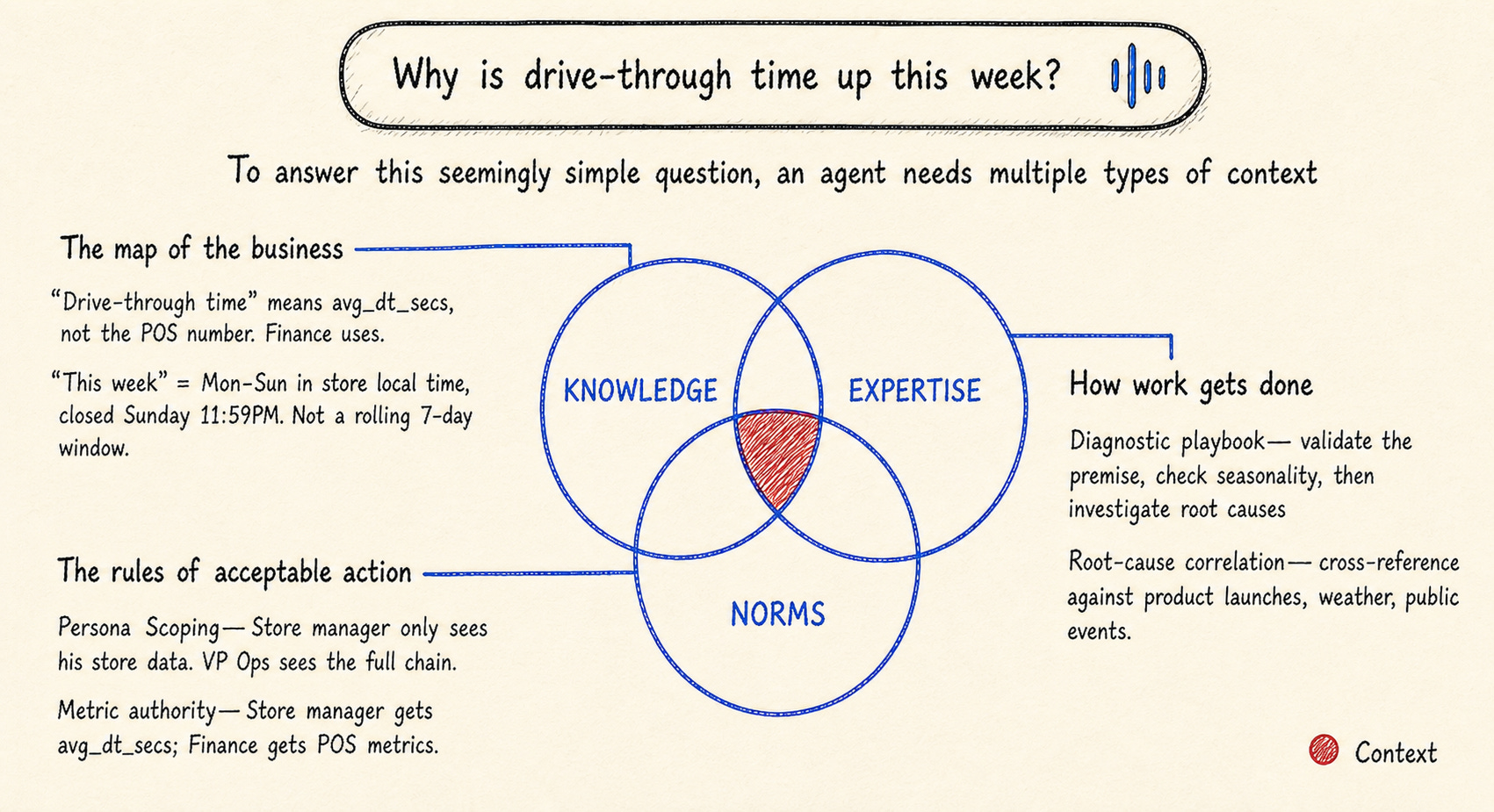
Knowledge is the map of the business. This includes entities, definitions, metrics, relationships, taxonomies, and glossary terms. In short, it’s the ontology of how the company interacts and talks. This lets a human and an AI system agree on what a customer, product, policy, and revenue actually mean.
Expertise is how work actually gets done. This includes procedures, workflows, tool choices, task decomposition, playbooks, and the practical know-how of regular projects like running the monthly close, qualifying an inbound lead, or triaging a support escalation. Today, this lives across SOPs, tickets, Slack threads, and the heads of the three people who have been on the team long enough to remember why we do it that way.
Norms are the rules of acceptable action. This includes policies, permissions, obligations, approval paths, exception handling, and compliance constraints. Norms tell the agent not just what is true and how to do it, but what is allowed. For example, they govern which customer can be offered which discount, which actions need a human approver, and which data cannot leave which jurisdiction.
What an Enterprise Context Layer Actually Is
Let’s get right to it.
An enterprise context layer is the system that turns knowledge, expertise, and norms into machine-usable context for AI — across the heterogeneous landscape of data, business systems, and AI. It exists so agents can operate with shared meaning, with the right information at the right moment, and with the governance needed to act safely and consistently.
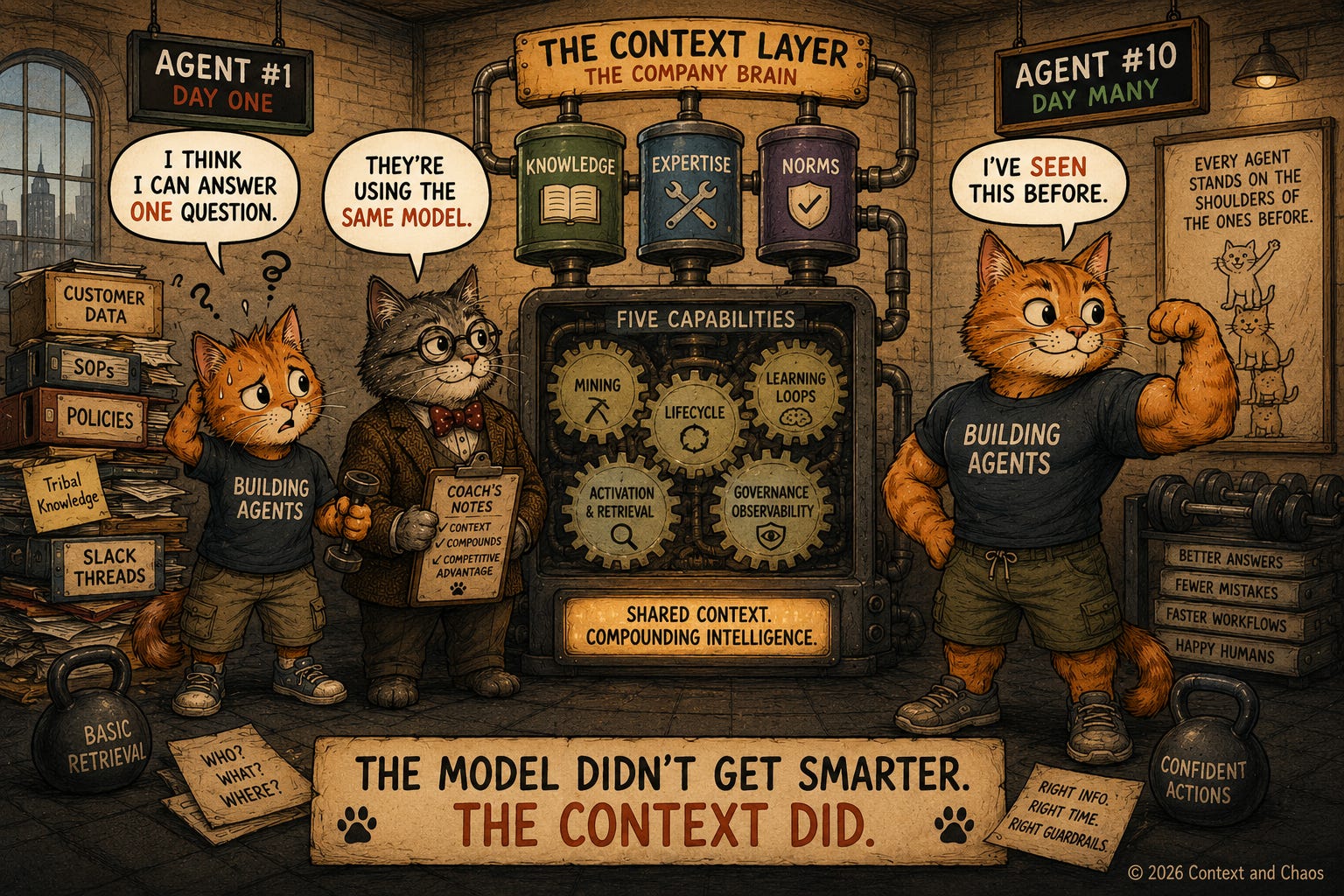
Think of the context layer as a shared enterprise brain. It’s the foundation that every agent in your company reaches into, learns from, and contributes back to. That’s what makes the tenth agent dramatically better than the first, because each one inherits what the previous ones already learned.
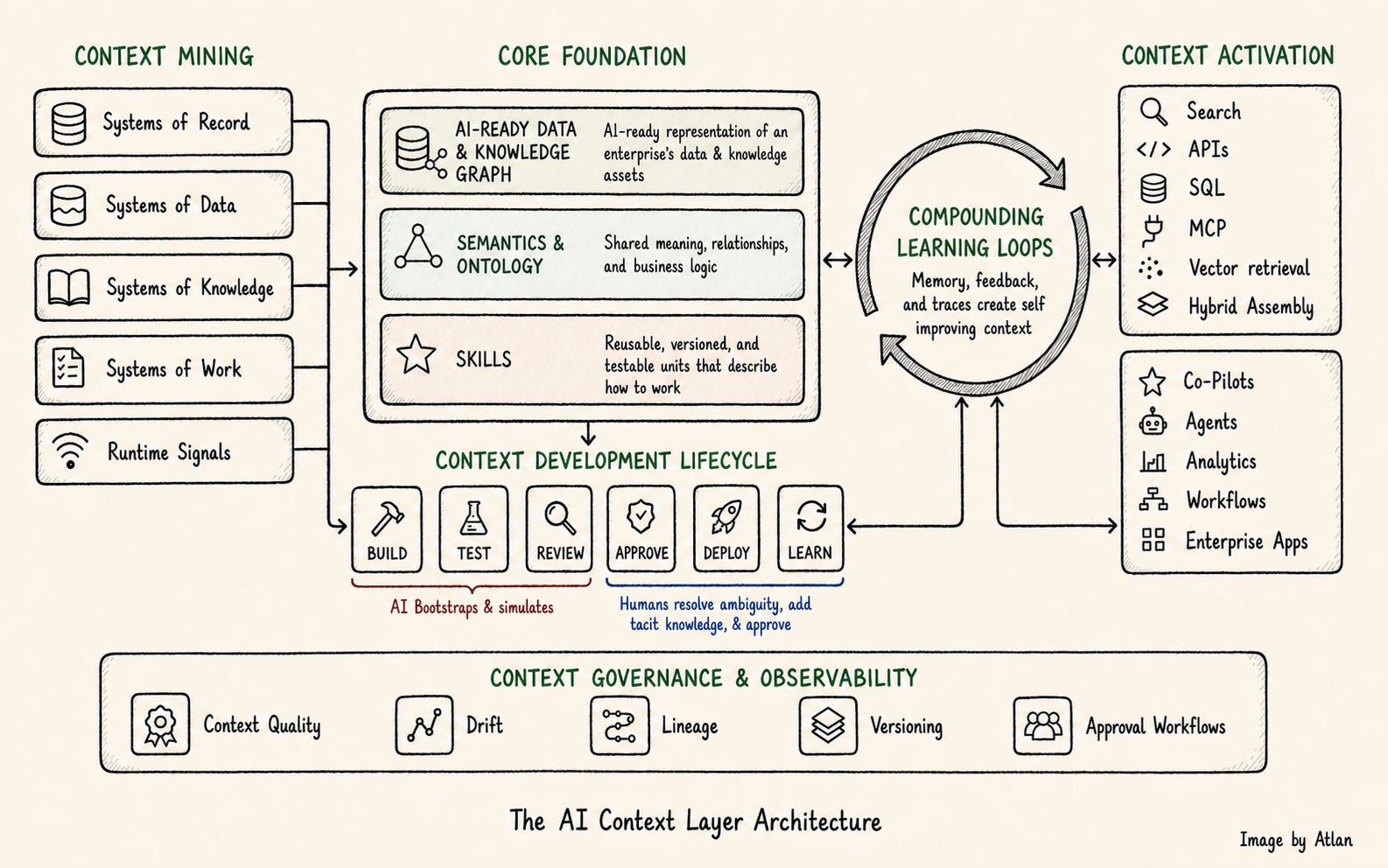
The context layer has two halves working together:
A core context substrate: The machine-usable substance of context itself, made of three integrated parts.
Five capabilities: The operating system that produces, governs, delivers, and continuously improves that substrate over time.
Let’s go deeper into both.
Part 1: The core context substrate
The substrate is the machine-usable representation of enterprise context. It’s made of three tightly integrated parts: AI-ready data, semantics & ontology, and skills. Together they answer three different questions an agent needs to act:
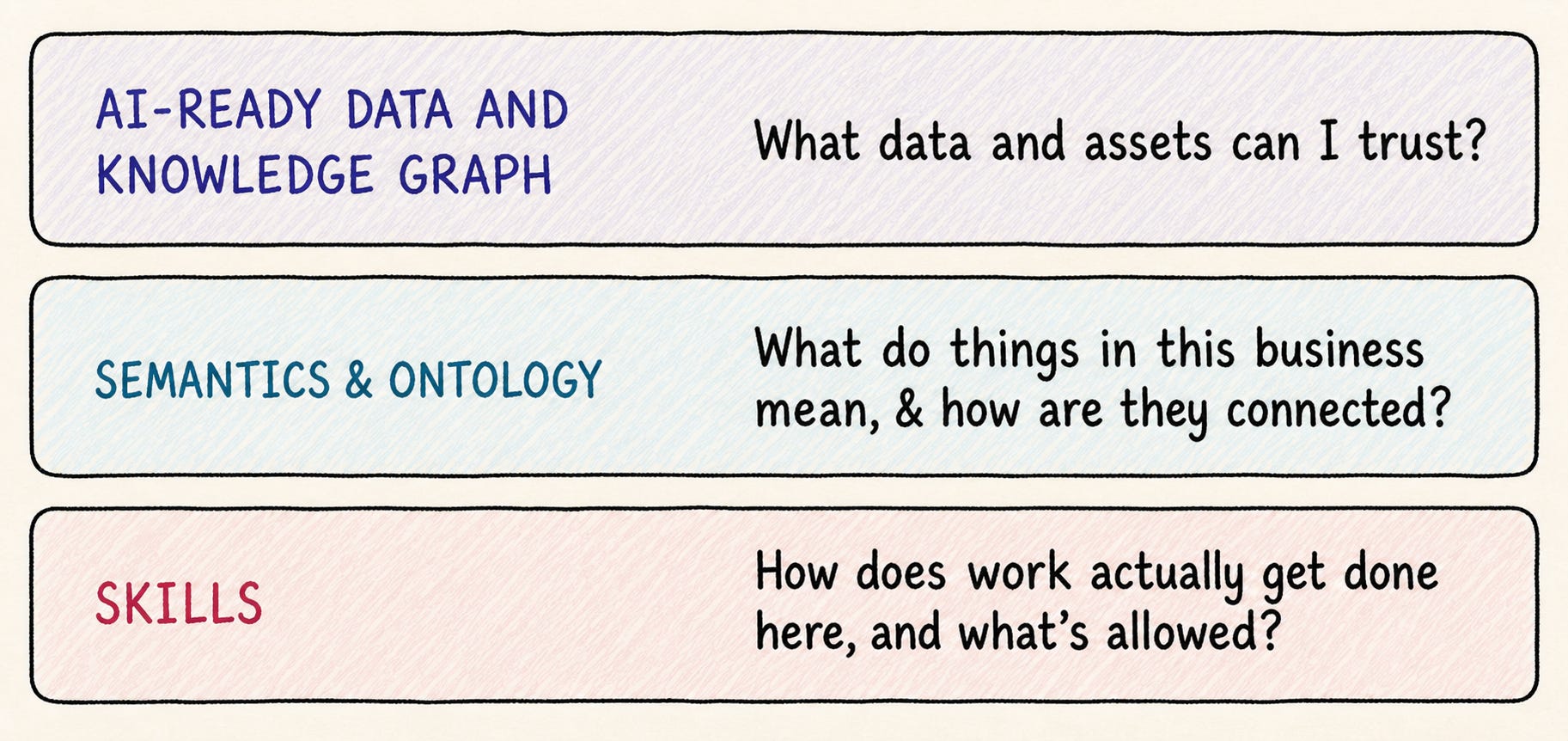
What data and assets can I trust? → AI-Ready Data & Knowledge Graph
What do things in this business mean, and how are they connected? → Semantics & Ontology
How does work actually get done here, and what’s allowed? → Skills
You can’t have one without the others. Data without semantics is uninterpretable. Semantics without data is theater. And both without skills can describe the business but not operate it.
On a whiteboard this is clean. In a real enterprise, every one of these three lives in a different team, a different tool, and a different decade of decisions. Closing that gap is the whole game.
1. AI-ready data & knowledge graph
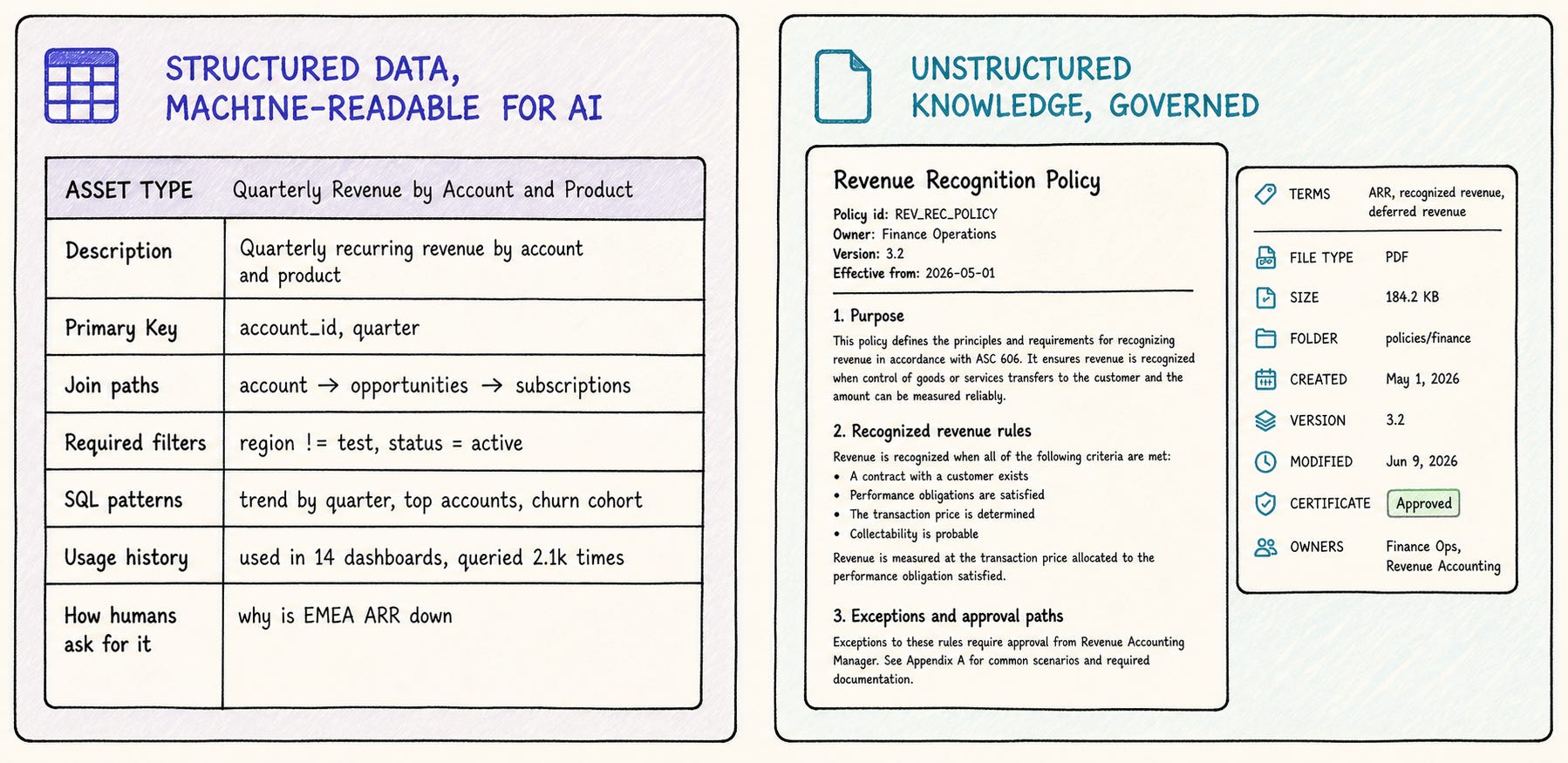
This is the foundation: the integrated, trusted, and AI-ready representation of an enterprise’s data and knowledge assets. It solves two distinct problems.
First, it makes structured data machine-readable for AI. That means enriching tables and datasets with the context agents actually need: descriptions, primary keys, join paths, required filters, SQL patterns, usage history, and the ways humans typically ask questions of that data.
Second, it makes unstructured knowledge accessible in a governed way. That means identifying canonical facts, indexing files and folders, applying classification logic, and deciding what is allowed to become part of the enterprise knowledge graph.
Canonical knowledge: The narrative that defines how the company thinks, sells, builds, and speaks. Strategy documents, mission and values, brand voice guides, product positioning, principles, frameworks, and org charts. These are the ideas experienced employees carry in their heads and every new hire absorbs in their first 90 days.
There’s also an important shift happening here. As MCP emerges as a key protocol, and as more core systems expose high-quality MCP servers, there’s a real possibility that agents may not need every asset to be physically centralized. If they understand how to use the MCPs, the tools, and the rules of the systems where knowledge already lives, they may be able to traverse the enterprise knowledge graph directly and retrieve verified context from the source.
2. Semantics & ontology — the map of the business
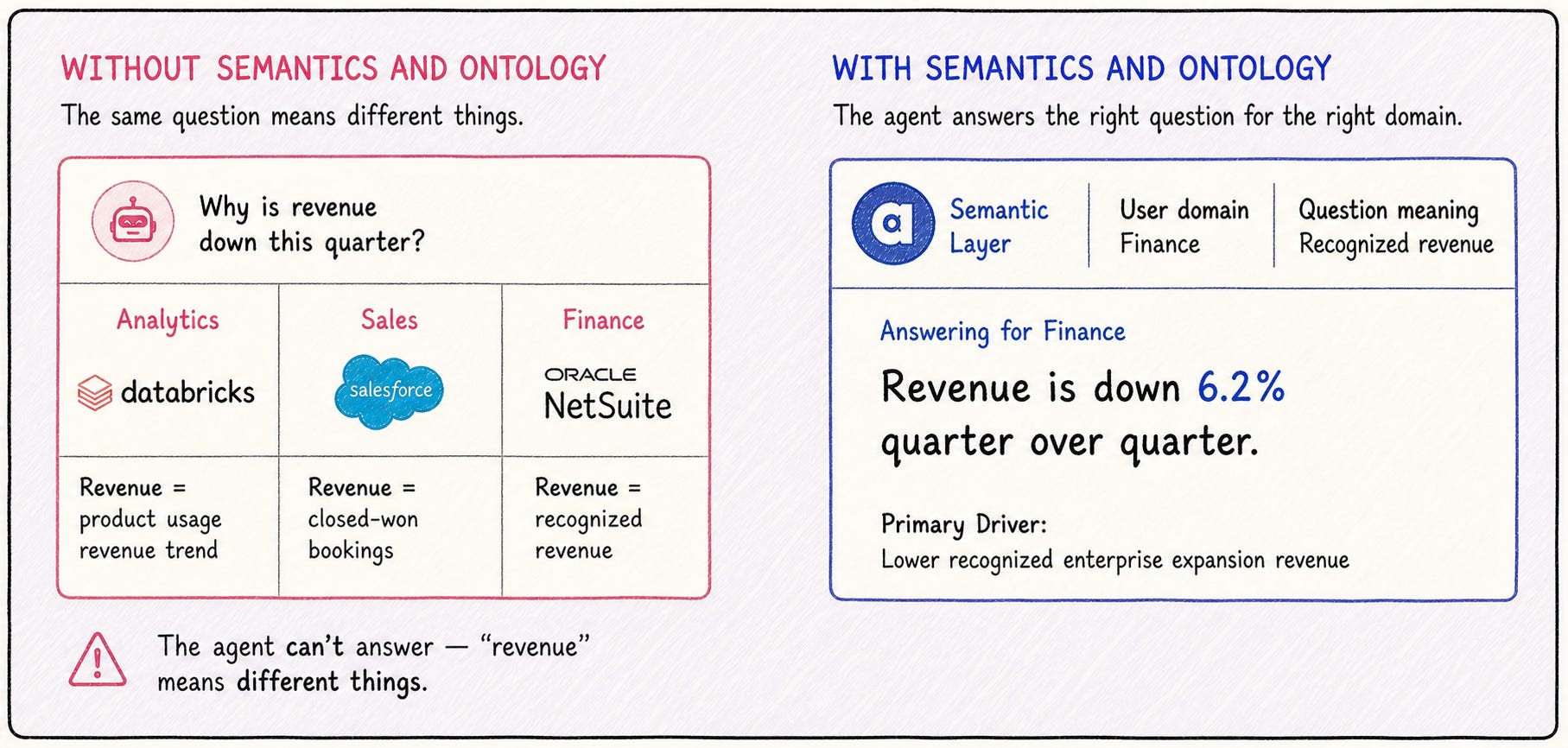
If AI-ready data tells you what exists, semantics and ontology tell you what it means and how it connects. This is the map of the business.
It encodes two different things:
Semantics: Shared definitions of business concepts. Glossary entries, metric definitions, and the vocabulary every team uses and often disagrees on — what counts as an active customer, gross margin, or escalated incident.
Ontology: The structure of how those concepts relate. The relationship between Customers, Accounts, and Transactions, or between Products, SKUs, and Inventory. Entities, relationships, knowledge graphs — what allows agents to reason across the business instead of treating each system as an island.
No real context layer is complete without all three. Without semantics and ontology, retrieval is brittle. Without canonical knowledge, agents have no idea what the company is actually trying to do.
Ontologies and knowledge management are not new disciplines. What is new is that AI can now build, maintain, and curate encoded knowledge at the pace the business actually moves — reading query logs, reconciling conflicting documents, detecting drift between what a brand voice guide says and what marketing actually publishes. That work is the job of Context Mining and the Context Development Lifecycle, which we’ll get to in Part 2. The point here is that a living knowledge model is finally tractable at enterprise scale.
This isn’t a fringe idea anymore. Anyone who’s worked with agents knows context isn’t a nice-to-have, it’s everything. Anthropic put it plainly: “context is a critical but finite resource for AI agents.” Andrej Karpathy called the discipline of getting it right “the delicate art and science of filling the context window with just the right information for the next step.” Tobi Lütke described it as “the art of providing all the context for the task to be plausibly solvable by the LLM.” When the people building the frontier models and the people running the businesses are converging on the same word, it’s worth getting the architecture under that word right.
3. Skills — reusable procedures, processes, and norms
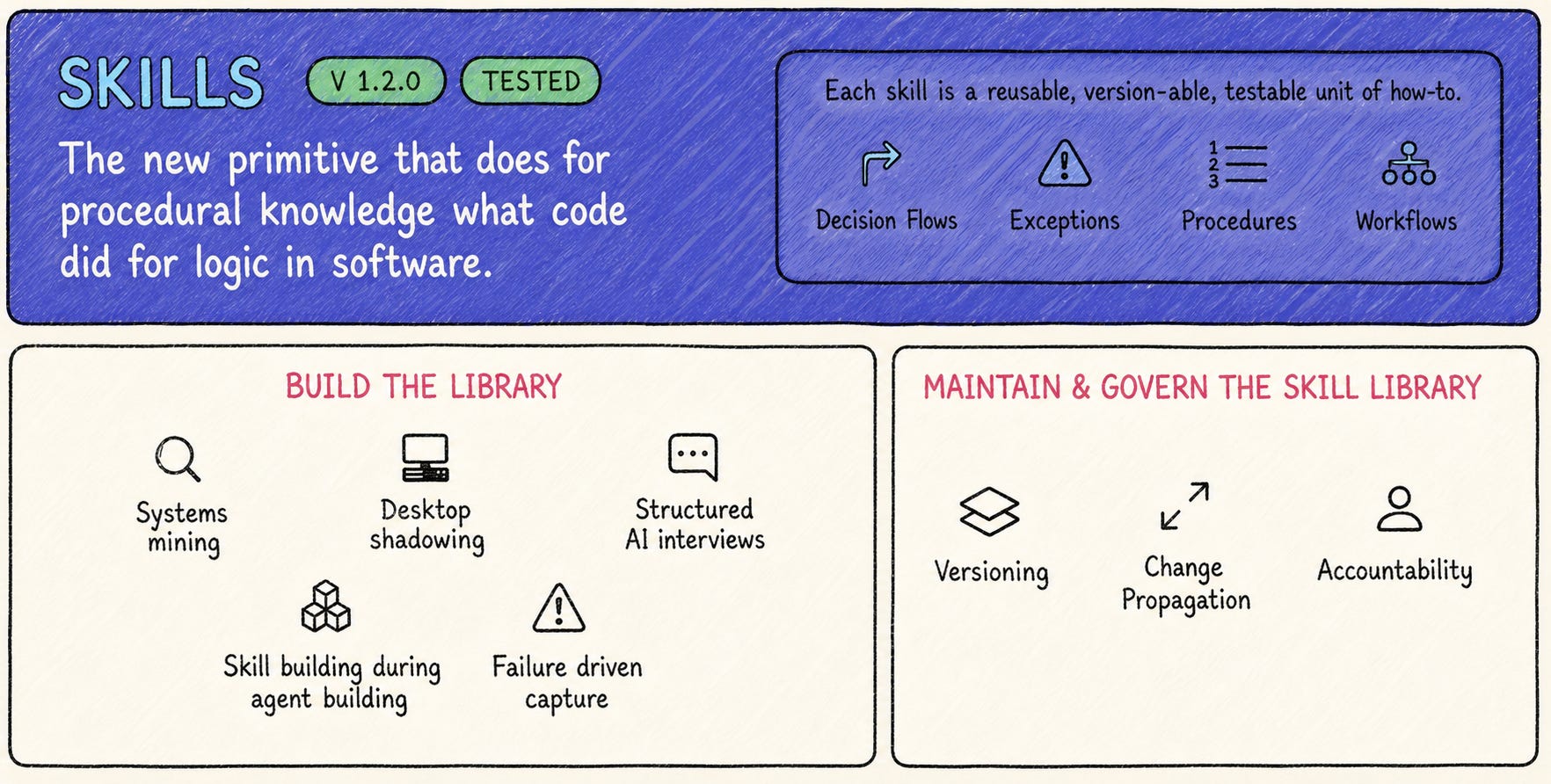
Knowing what something means is not the same as knowing what to do next. A semantic layer can tell an agent what gross margin is. It cannot tell the agent how to close the month, when to escalate an exception, or which approval path matters in practice. That’s a different layer of enterprise intelligence entirely.
This is where Skills come in. Skills make procedural knowledge — the way work gets done, and the norms that constrain it — durable and machine-usable.
A skill is the new primitive that does for procedural knowledge what code did for logic in software. Each skill is a reusable, versionable, testable unit of how-to. The context layer is the system that manages skills through version control, lifecycle management, and unit testing.
Two problems make skills hard, and they map cleanly onto the capabilities in Part 2.
The first is building the library — how do you reverse-engineer a skills library inside a company that already exists? You can’t write 10,000 skills in a quarter, and the most important procedural knowledge isn’t documented anywhere. This is a Context Mining problem, and we’ll get to the specific methods (skill-building during agent-building, systems mining, failure-driven capture, desktop shadowing, structured AI interviews) when we cover that capability.
The second is maintaining and governing the library — how do skills stay current as the business changes, how do changes propagate when an upstream skill is updated, and where does accountability sit when something goes wrong? This is a Context Development Lifecycle problem, and it’s where the organizational design questions live.
For the substrate itself, the takeaway is simpler: Skills give the context layer a way to encode how work gets done and what’s allowed in a form that’s reusable, versioned, and testable — the same way code did for software logic. That’s the new primitive. Everything else is operating system around it.
Part 2: The five capabilities
The substrate is what the context layer is. The five capabilities are what it does — the operating system that produces context from enterprise reality, governs it through a lifecycle, compounds it through learning, delivers it where agents work, and keeps it trustworthy over time.
Capability 1: Context mining
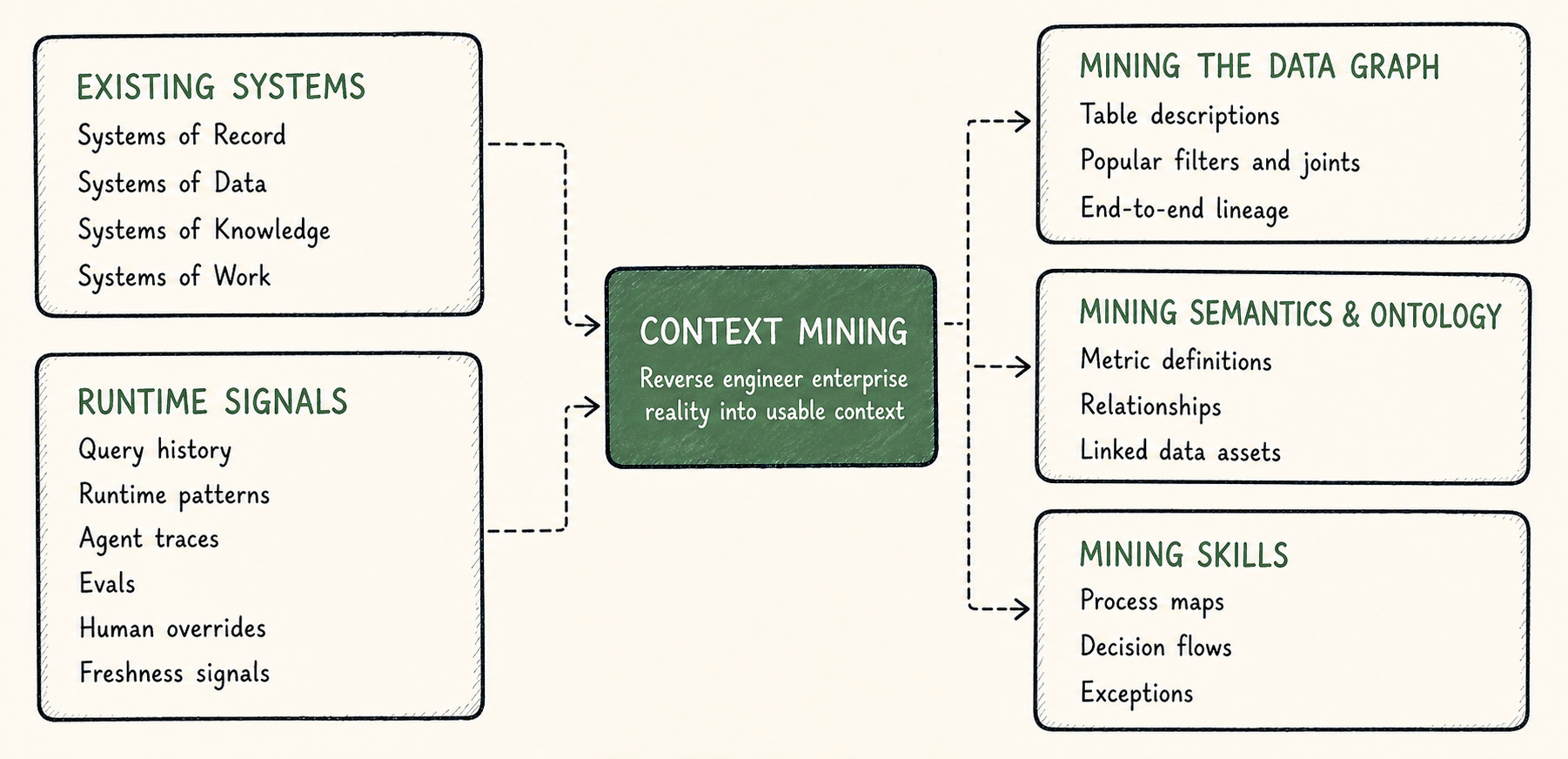
If you want to understand how a business thinks it runs, read its documentation. If you want to understand how it actually runs, observe its systems.
A surprising amount of business context is hidden across business systems, knowledge systems, Slack, email, tickets — and the trail of how people actually use all of them. The first job of the context layer is to connect to that fragmented reality and reverse-engineer business operations from it.
Context mining draws from two kinds of sources:
Existing business and knowledge systems: Systems of record (Salesforce, ServiceNow), systems of data (Snowflake, Databricks, BI dashboards), systems of knowledge (Notion, Confluence, ticketing systems, email), and systems of work (Slack, project tools, the trail of where decisions happen).
Runtime signals: Query history, usage patterns, agent traces, evals, human overrides, and freshness signals.
You can think of the output as a raw context substrate flowing into a context lake — the way enterprises decades ago began piping their data into data lakes. But mining is much more than ingestion. It’s the work of producing each of the three substrates from enterprise reality.
And here’s where my scar tissue starts itching, because we’ve watched this movie before. The semantic layer had near-perfect problem-value fit and still never became a standalone category. The data lake promised one place for everything and too often became a swamp nobody trusted. A context lake that’s just a dumping ground for raw context will meet exactly the same fate. The difference between a context layer that compounds and a context graveyard is everything that happens after ingestion, which is the rest of this section.
Mining semantics and ontology
The semantic layer of a real business doesn’t live in one place. It’s scattered across SQL query patterns, undated decks, Notion pages, Slack threads, and people’s heads. Mining it well is what makes the difference between a glossary nobody trusts and a living knowledge model.
A few examples of what this actually looks like in production:
AI reads your SQL query history, notices that Sales and Finance use different definitions of Annual Recurring Revenue, and surfaces the conflict for a human to decide which should be used company-wide.
Someone asks AI about the escalation threshold, but four documents disagree. AI reads them all, weighs their last-updated dates and author seniority, drafts two candidate versions, and brings them to a human.
In each case, AI does the heavy lifting and humans decide. That’s what makes a living knowledge model finally tractable at enterprise scale.
Mining skills
Mining procedural knowledge is even harder than mining semantics, because most of it was never written down. The work of building a Forward Deployed Engineering team manually is one answer, but the more durable answers are system-led and becoming core to the context layer:
Skill-building as part of agent-building: Garry Tan’s skillify library is one example. Do the work manually with the agent once, then use AI to examine the session, extract the repeatable pattern, write the skill file with triggers and edge cases, and register it. In this model, we can bootstrap an agent with 50% autonomy and keep improving it until it reaches at least 90%.
Mining existing systems: How much can we create process maps from event logs, or decision flows from email and Slack patterns? This is where systems of work become a goldmine.
Failure-driven skill capture: Don’t try to encode every skill upfront. Run the agent, watch where it fails, and capture the missing context at the point of failure. Each failure is a signal where the agent didn’t know something and a skill is needed to fill that gap. The library grows where the agents actually work, not where someone guessed they would.
Desktop shadowing: Shadow what top operators actually do on their machines — clicks, keystrokes, app switches — and reverse-construct their workflows. This captures the complex desktop processes that systems mining misses.
Structured AI interviews: The most important procedural knowledge is never logged anywhere — it’s judgment. AI can run structured conversations with employees to surface the exceptions, workarounds, and decision rules that observation can’t reach. “Walk me through the approval process. How do you actually decide?”
The winning skills library will be assembled from all of these: mining for what executed and how, interviews for why it happened, and agent runs for the gaps these approaches don’t reach. None of these methods produce a finished skill on their own — they produce candidates that the Context Development Lifecycle then tests, reviews, approves, and deploys.
Capability 2: Context development lifecycle
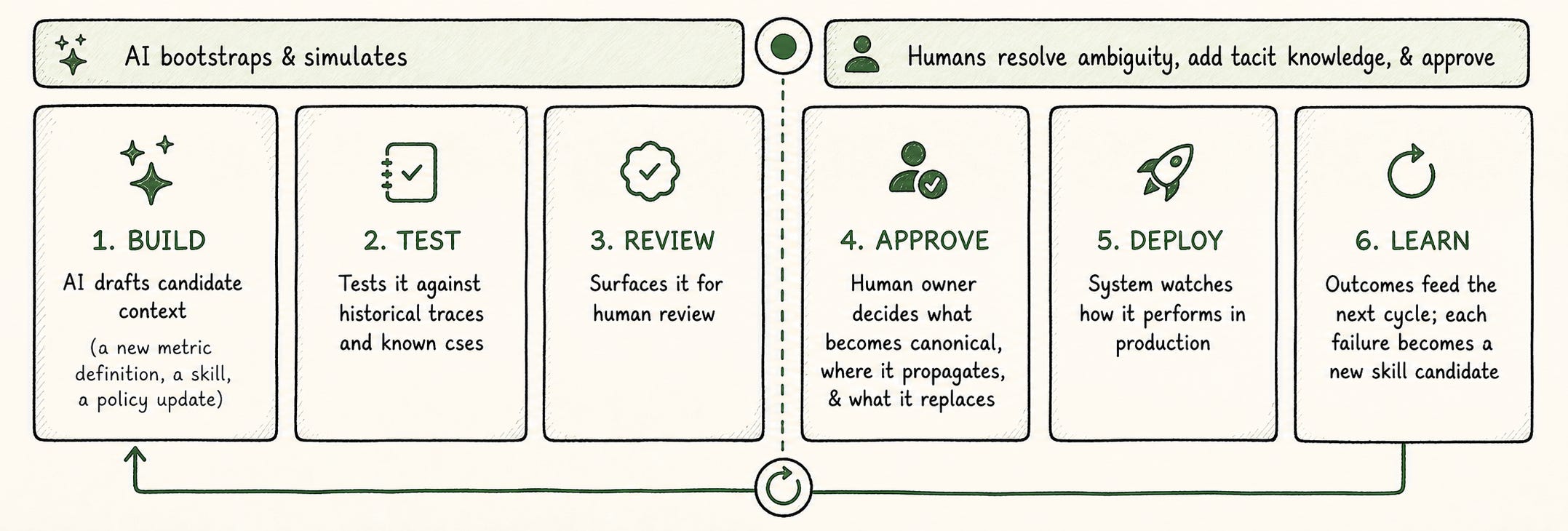
Just as software engineering created the software development lifecycle to manage how code is built, reviewed, versioned, and deployed, companies that want a shot at truly becoming AI-native will need a context development lifecycle to manage how context is created, tested, approved, deployed, and retired.
Context can no longer live as scattered prompts, hidden instructions, and isolated team-level decisions. It has to become a first-class asset: reusable, reproducible, versioned, and governable.
The lifecycle has six stages — and the line between AI and humans moves through it:
Build → Test → Review: AI bootstraps and simulates. AI drafts the candidate context (a new metric definition, a skill, a policy update), tests it against historical traces and known cases, and surfaces it for review.
Approve → Deploy → Learn: Humans resolve ambiguity, add tacit knowledge, and approve. A human owner decides whether the candidate becomes canonical, where it propagates, and what it replaces. Once deployed, the system watches how it performs and feeds outcomes back into the next cycle.
This is also where new operating roles emerge. Not every piece of context should be editable by everyone. Some context will need owners or approvers. Some updates will remain local to a team; others will need to be promoted into a shared enterprise layer to propagate into downstream systems.
Change propagation is crucial. If a company changes its core ICP or redefines a key persona, that’s not a small edit — it’s a structural change to enterprise understanding. The system should trace the lineage of that change across every downstream context artifact, every evaluation, and every agent that depends on it. The real governance challenge isn’t just storing context, but understanding the blast radius of change.
Consider a real cascade. A company’s positioning document might be a CMO-approved skill. That positioning feeds the social media skill that drafts LinkedIn posts, the SDR pitch skill, and the analyst call skill. When the CMO updates positioning, what happens? Does the change propagate automatically? Does it queue for review by each downstream skill owner? Does the social media skill keep using the old version until someone certifies the new one? These are not theoretical questions — they’re the difference between a context layer that compounds and one that contradicts itself.
And when an agent uses these skills in a real task and something goes wrong, where does accountability sit? With the skill that misfired, the skill that fed it, or the agent that composed them? The next era of innovation will come from solving these problems, and the answers will look much more like organizational design than prompt engineering.
My mental model is simple: AI will do most of the work, and humans will increasingly step in only for judgment, certification, and exception handling. But for that to work, every context agent in the lifecycle needs a specialized role, a clear scope of authority, and a human accountability path. The infrastructure has to support versioning, provenance, simulation, approval workflows, rollback, and escalation to the right people at the right moment.
In practice, this might look like a domain owner waking up to a Slack notification asking them to approve a proposed metric change. A GTM leader reviewing the impact of a new persona definition before it propagates into downstream sales and support agents. A policy owner rejecting an automatically inferred update because it conflicts with a compliance boundary.
Capability 3: Compounding learning loops
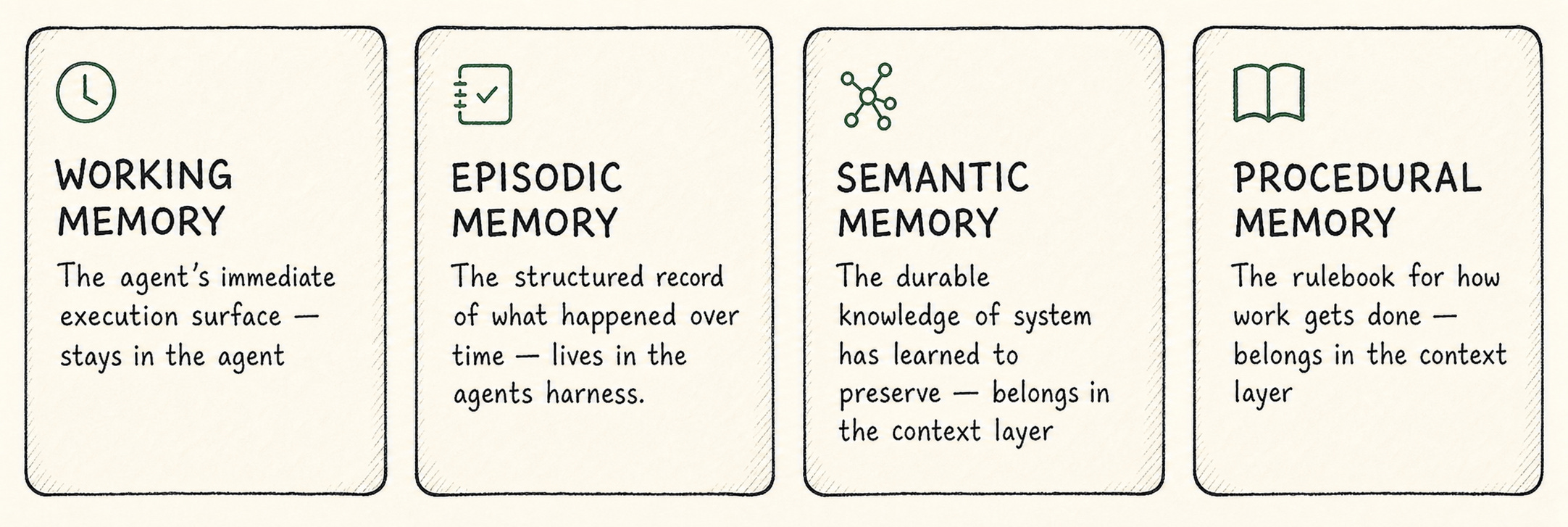
Memory is one of the muddiest words in the entire agent stack. People use it to mean radically different things: the active context window, a user profile, a trace log, a vector database, a preference store, or the whole knowledge base behind an agent. That ambiguity matters, because these don’t all play the same role.
A useful way to think about memory is across four types:
Working memory: The agent’s immediate execution surface.
Episodic memory: The structured record of what happened over time.
Semantic memory: The durable knowledge the system has learned to preserve.
Procedural memory: The rulebook for how work gets done.
Architecturally, this distinction matters. Working memory and a thin layer of episodic memory belong close to the agent harness — they’re part of execution state. Semantic memory and procedural memory belong inside the context layer, because they represent knowledge and skills the organization wants to preserve, govern, and make portable across agents, tools, and workflows.
This is where compounding learning loops become essential. Episodic memory and traces shouldn’t just sit there as logs. They should feed feedback loops that improve the company’s encoded knowledge and skills over time. Through traces, evals, corrections, human review, and certification, temporary experience gets converted into durable context. A clarification becomes a saved preference. A repeated exception becomes an explicit policy. A successful resolution becomes reusable precedent. A workflow that consistently works becomes part of the organization’s procedural memory.
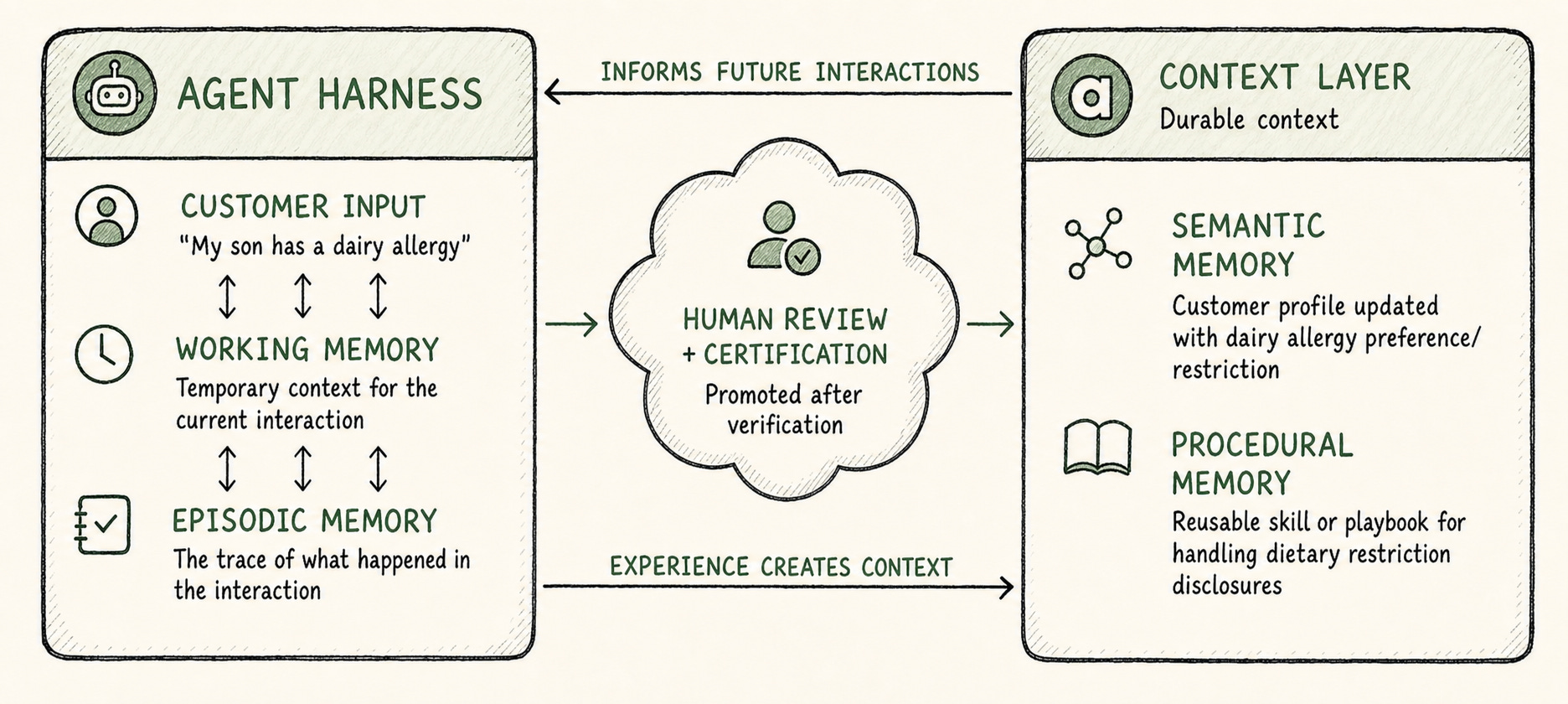
Take a simple example. A contact center agent is helping a customer, and during that interaction the customer mentions that their son has a dairy allergy. In the moment, that detail lives in working memory so the agent can respond appropriately. The interaction itself becomes part of episodic memory as a trace of what happened. But if the system determines that this detail is important, verifies it, and promotes it, it becomes semantic memory: the customer profile is updated to reflect that this household includes a son with a dairy allergy. From that point on, future agents do not need to rediscover it — the organization has learned.
Or take, for instance, when AI notices that the brand voice guide was last updated 18 months ago. AI compares it to the last 90 days of marketing, blog content, and customer emails, surfaces how they’ve drifted from the old guide, and drafts an updated version for a human editor.
This bottom-up flow is what makes the context layer compound. As agents interact with users, they uncover new preferences, clarifications, exceptions, and playbooks. A team discovers a better workflow. A region establishes a more effective operating pattern. A support agent learns a new resolution path that consistently works. These should not remain trapped inside local interactions. AI should detect those emerging patterns, propose updates to the shared context, and ask the right person whether the learning should stay personal, move to the team level, or be promoted to the enterprise layer.
That is the deeper role of memory in the context layer. It’s not just about helping one model remember one conversation. It’s about deciding what should remain local to execution, what should be archived as history, and what should be promoted into shared enterprise knowledge. Every interaction makes the layer smarter — and the smarter the layer gets, the better every future agent performs.
Capability 4: Context activation & retrieval
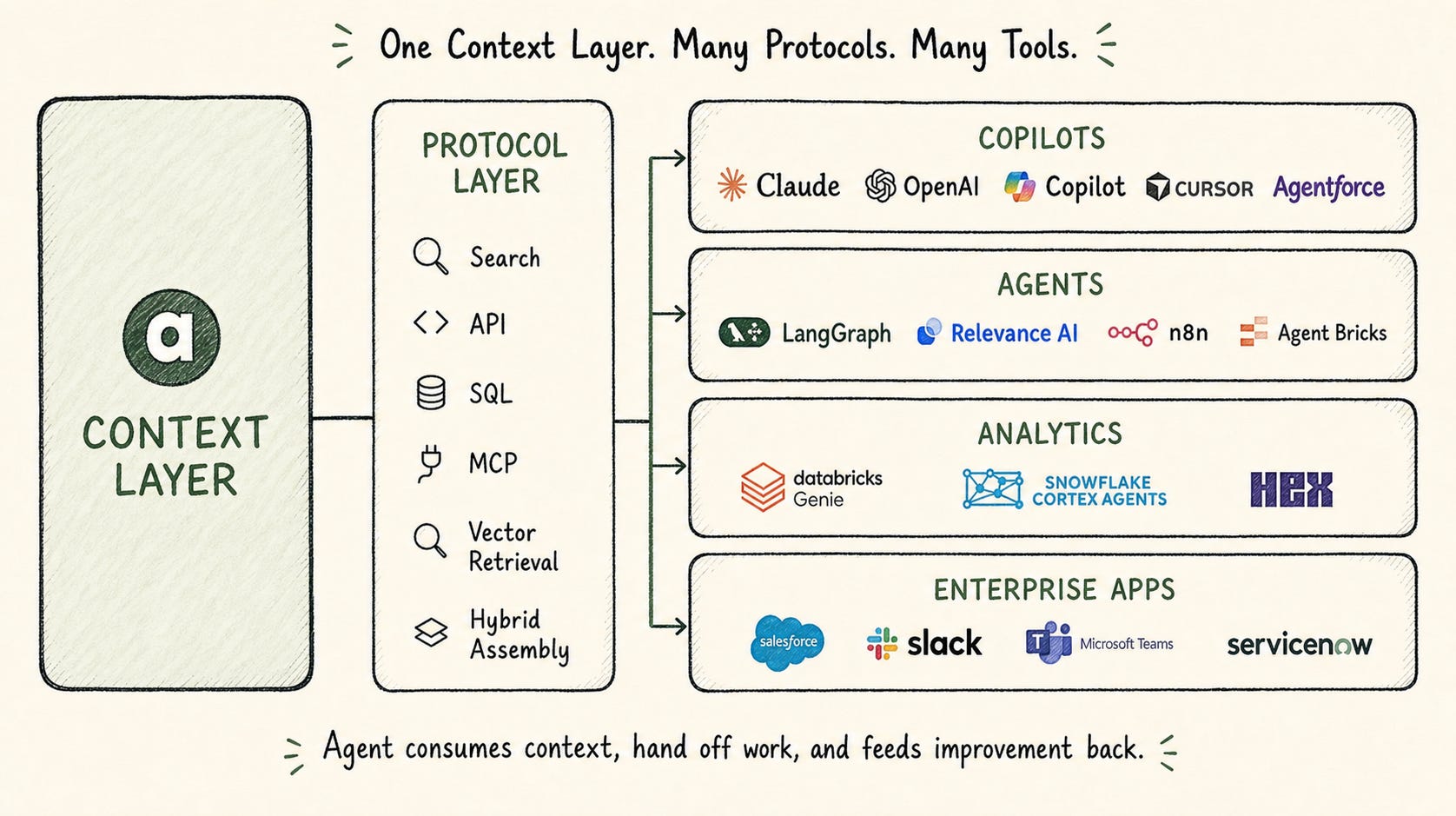
Context is only valuable if it reaches the right human or agent, in the right interface, at the right moment of work.
This capability activates context so it shows up where decisions get made: copilots, search, analytics tools, workflows, code editors, agent frameworks, and the applications where work already happens.
As context becomes an enterprise asset, it has to survive a heterogeneous world of interfaces, protocols, and retrieval patterns. There will not be one winner. Some systems will consume context through MCP. Others will use APIs, SQL, search, vector retrieval, graph traversal, or hybrid runtime assembly.
That means the context layer cannot be tied to any one interface, protocol, or infrastructure choice. It cannot assume graph or vector search — or any single agent standard — is always the answer.
The data lakehouse became the open architecture that kept data portable across engines, tools, and clouds. The context lakehouse could follow a similar pattern, becoming the open substrate that keeps context portable across agents, models, interfaces, and ecosystems. Not just a place to store context, but the persistent architecture that makes context reusable in production.
This activation layer will likely include:
A context lake for raw and refined context artifacts.
Semantic and relational structures that preserve meaning, lineage, and entity relationships.
Memory and trace stores that capture feedback, outcomes, and historical decisions.
Retrieval and indexing systems for search, vectors, graphs, and hybrid assembly.
Interface layers that expose context through APIs, SQL, MCP, search, and whatever comes next.
In the short term, this means solving a very practical problem: translation.
As the agentic wars continue, different platforms expect context in different native forms. Even inside the Google ecosystem, conversational analytics in Looker needs context as a LookML model, while Gemini Enterprise wants it as a skill file. Snowflake wants Semantic Views. The market is still converging, and the context layer cannot wait for standards to settle. It has to meet ecosystems where they are.
That makes interface adaptation a core capability: taking shared enterprise context and translating it into the native frameworks each platform can consume. The winning architecture will not force every ecosystem to speak one language. It will translate canonical context into many local dialects.
Capability 5: Context governance & observability
The other four capabilities make the context layer functional. Governance and observability are what make it trustworthy.
In an AI-first operating model, every business change and every agent interaction creates new context. Without governance, that context decays into a fog of unverified prompts, drifted definitions, and competing instructions. With governance, it becomes infrastructure: certified, observable, and continuously improving.
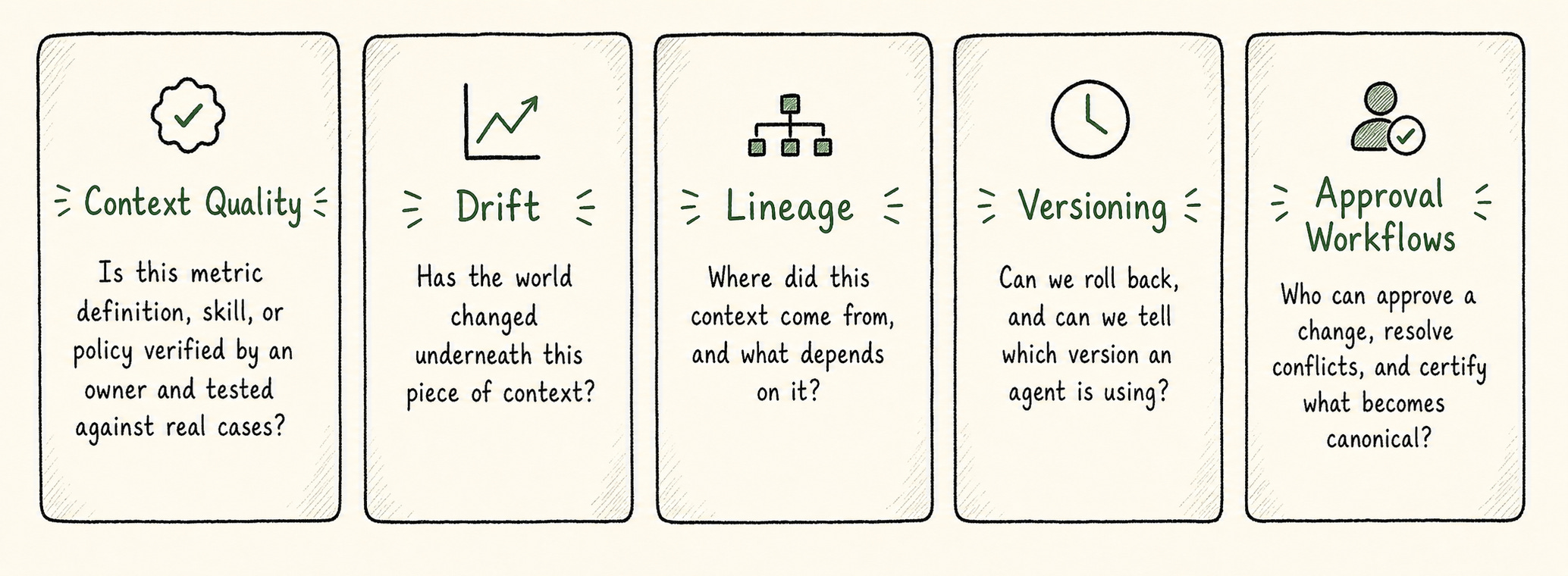
Governance and observability span five concerns that have to be live across every other capability:
Context Quality: Is this metric definition, skill, or policy verified by an owner and tested against real cases?
Drift: Has the world changed underneath this piece of context? Is the brand voice guide still aligned with what marketing actually publishes? Is the gross margin definition still consistent with how Finance closes the books?
Lineage: Where did this context come from? Which source documents, traces, or decisions produced it? Which downstream agents, evals, and workflows depend on it?
Versioning: Can we roll back? Can two agents disagree because they’re on different versions of the same skill, and can we tell?
Approval workflows: Who’s allowed to merge a change that affects multiple teams? Who resolves a conflict between local context and global policy? Who certifies that a newly discovered playbook is real, safe, and broadly reusable?
These aren’t prompt-engineering questions. They’re organizational design questions, and they’ll define whether enterprise AI becomes trustworthy at scale.
Compounding only works if there are clear accountability loops. Without them, the context layer becomes another data lake — a graveyard of artifacts no one trusts. With them, it becomes the shared brain the rest of the AI stack reaches into with confidence.
The shape of the market today
If you draw the market map of context-layer companies right now, you’ll find dozens of logos crammed into a single category. Some of them belong there. Most of them don’t — they’re building something else that happens to have a context layer inside it.
Three patterns are worth pulling apart:
Agent builders building context for their own vertical. Sierra is an agent company. The context layer they’re building is real, but it’s specific to customer experience agents — their semantics, their playbooks, their memory. It only operates inside the Sierra product. Almost every vertical agent company shipping today is doing some version of this.
Platforms building context for their own product. Snowflake is building Snowflake Intelligence — a conversational analytics product — and the context layer underneath it (Semantic Views, Cortex) is specific to data analysis on Snowflake-resident data. That’s a valuable context layer. It’s also not the enterprise context layer.
Specialists building one component of the substrate. This is most of the market map. Memory companies (mem0, Letta, Zep, Cognee) work on a piece of the compounding learning loop. Process mining and human decision trace companies (WIQ, Klarity, Worktrace, Skan) work on capturing procedural knowledge. Vector retrieval companies (Pinecone, Chroma, Milvus, Turbopuffer) work on activation. Semantic specialists (honeydew, RelationalAI) work on parts of the ontology. Each of them is excellent at one piece of the substrate or one capability of the operating system. Most of them will end up integrated into a context layer rather than being one.
None of this is new to me. When Jaya Gupta and Ashu Garg called context graphs “AI’s trillion-dollar opportunity,” the thesis landed because it named something every team was already feeling: systems of record capture what happened but lose the why. Benn Stancil has been circling the same gap from the data side. The thesis is right. The open question is the one the semantic layer never answered: who actually assembles it, and does it survive contact with a real enterprise?
None of this is unhealthy. Every early ecosystem looks like this. After Snowflake’s IPO in 2020, the modern data stack exploded into thousands of companies — observability, transformation, reverse ETL, catalogs, semantic layers, lineage, quality, ELT, lakehouses. It took five years and a lot of M&A for the picture to consolidate, and even now the categories that survived all sit on top of a shared substrate.
The context layer will consolidate the same way, but I think it consolidates harder and faster.
Here’s why. The whole point of the context layer is that it’s shared. If a Fortune 500 has one context layer for its CS agents, another for its data analysis, a third for memory, and a fourth for process mining, it doesn’t have a context layer at all. It has four context islands. The compounding loop breaks the moment context can’t move between agents, products, and ecosystems. Enterprises won’t tolerate that for long.
The companies that will define this category are the ones that integrate across all three substrates and run all five capabilities as one coherent loop — mining context from every system, developing and governing it through a unified lifecycle, compounding it through every interaction, activating it across every interface and protocol, and keeping it trustworthy as the business evolves.
What it isn’t
How is a semantic layer different from an enterprise context layer?
There are three flavors of semantic layer in the market today:
Embedded semantic layers: Looker’s semantic model, Snowflake’s Semantic Views.
Universal semantic layers: Cube, AtScale, dbt’s semantic layer.
Universal context layers: Atlan.
Embedded semantic layers are tied to a single engine. Universal semantic layers are engine-agnostic but still scoped to metrics and dimensions for analytics. A universal context layer goes further: it covers the full substrate (data + semantics + skills) and runs all five capabilities — mining, lifecycle, learning, activation, and governance — across the heterogeneous landscape of enterprise AI.
Is an enterprise data catalog the enterprise context layer?
No. Data catalogs were built for humans, to help analysts find tables and understand columns. The primary producer and consumer of a context layer is AI. That changes everything: the substrate has to include skills and procedural knowledge, the lifecycle has to assume AI bootstraps most of the work, and the activation layer has to speak MCP, vectors, graphs, and APIs — not just a search box.
Is long-term memory the same as the enterprise context layer?
No. Long-term memory is one piece of one capability (the compounding learning loop). The context layer is the broader system that decides what gets promoted from memory into shared, governed enterprise knowledge.
So, back to that CIO. The honest answer is that nobody has fully built this yet. The pieces exist on the market map, but the category will be defined by whoever treats the context layer as one shared system instead of four context islands stitched together and hoping. A real one covers all three substrates and runs all five capabilities as a single loop. Everything else is a component wearing the category’s name.
That’s the bet I’m making. If you’re building this inside your own company, I want to know where this map breaks for you, what I’ve got wrong, and what I’m missing. Tell me. That’s the whole point of writing this down.
I’d love to hear what you think. Share your thoughts in the comments.
This is the map. Over the coming weeks, this series walks each territory in depth: building the substrate inside a company that already exists, governing the lifecycle when one change ripples across hundreds of downstream agents, and measuring whether any of it is working. The hard part was never the definition. It is the build.
The full canonical piece, with the complete architecture diagram and deeper treatment of each capability is here. This is the Context and Chaos edition.
The Cats of Context & Chaos
That’s all for this edition. Stay curious, keep exploring, and see you all in the next one!
About Context & Chaos
Context & Chaos isn’t just a newsletter. It’s shared community space where practitioners, builders, and thinkers come together to share stories, lessons, and ideas about what truly matters in the world of data and AI: context engineering, governance, architecture, discovery, and the human side of doing meaningful work.
Our goal is simple, to create a space that cuts through the noise and celebrates the people behind the amazing things that are happening in the data & AI domain.
Whether you’re solving messy problems, experimenting with AI, or figuring out how to make data more human, Context & Chaos is your place to learn, reflect, and connect.
Got something on your mind? We’d love to hear from you.
This is very interesting and similar to a concept that I’ve been researching - the semantic core - a governed model of
organisational intent that occupies a specific and previously empty position between strategic intent and operational execution. It argues that the absence of this artefact is the structural cause of enterprise transformation failure, and that making it explicit changes what is possible for any organisation attempting to evolve. Looking forward to hearing more.
Hi Prukalpa, thanks for writing this down. Sounds sensible and echoes my own work. However I am having a hard time translating your article into something useful.
Let me take this first at a personal level. For my own work with AI agents I have elements of a “context layer” everywhere. I use Karpathy’s LLM wiki for knowledge management, I use Graphify to create graphs of my source code, I use mempalace, beads, … any number of tools to create the context layer I need. It’s hard for me, so how can an enterprise do it? They are many times more complex than my simple needs. They have data catalogs, databases, systems of record everywhere. It sounds like a nice term but is context layer really a practical thing for enterprises to implement?