

Your AI can process a decade of data in seconds, sees patterns no analyst could, but it still misses the point.
It doesn’t catch the side-glances in a meeting, the hesitation before an answer, or the unspoken politics behind a “yes.” Those signals carry semantic density, the hidden layer of meaning beneath our words: the shared context, intuition, and assumptions that make communication human.
Semantic density is the compressed layer of context, culture, and lived experience that humans bring to every interaction. The difference between hearing words and understanding what’s actually at stake.
The organizations winning with AI are not chasing systems that “understand everything.” They are designing ones that know their limits and work within them.
The Context Paradox
Large language models excel when you give them explicit information. They thrive on structure, data, and clear instructions. Give them context, and they will reason across terabytes.
Yet no matter how much information you feed them, something essential remains out of reach. Semantic density still escapes them. It is the lived knowledge, the cultural shorthand, the intuitive sense of “what’s really going on.”
This is the difference between data and meaning. Humans carry semantic density in every question they ask and every decision they make. AI models, no matter how advanced, still operate without that invisible layer of understanding.
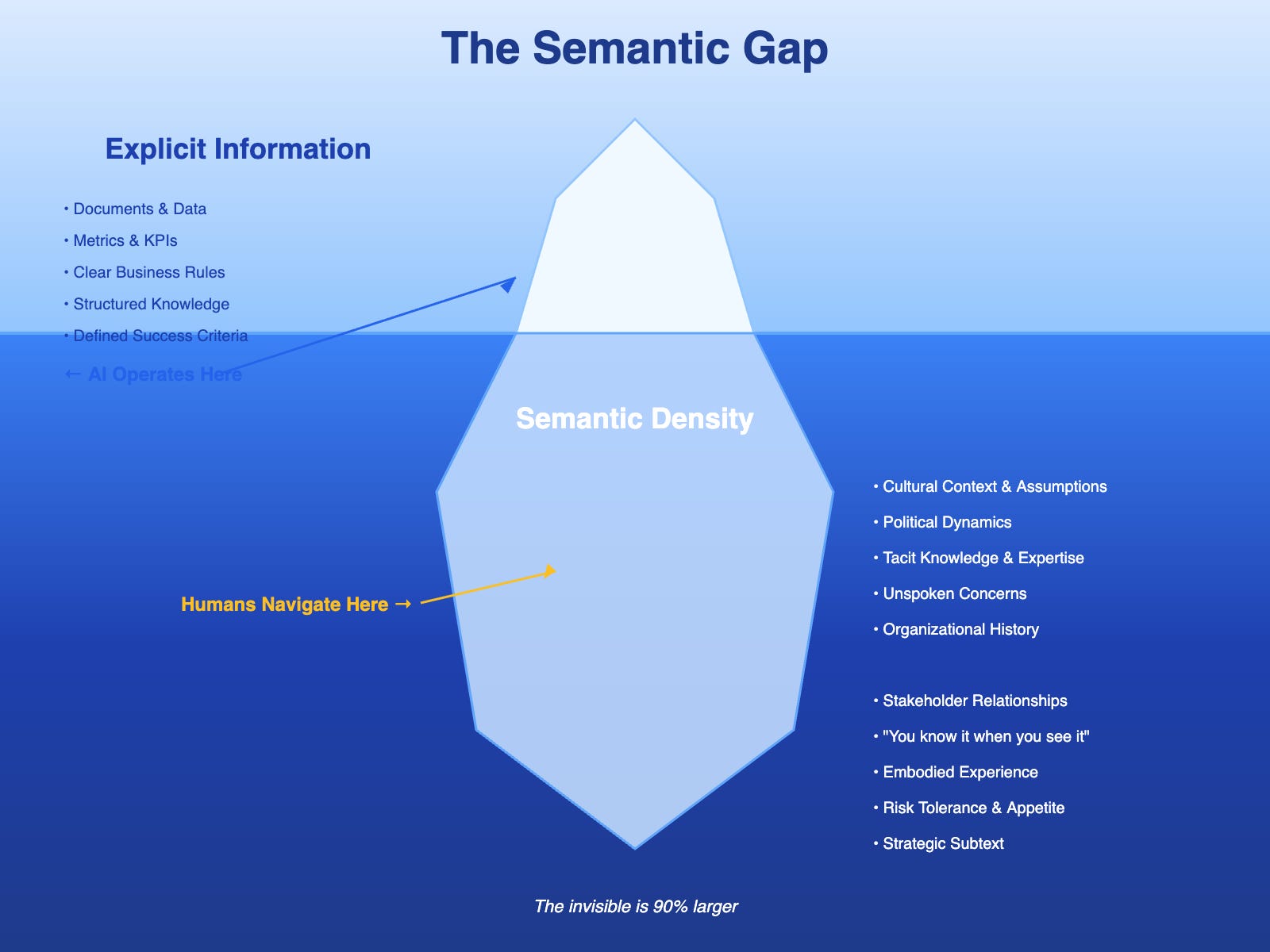
For frontier researchers, understanding and potentially bridging this semantic gap remains an open question. For business practitioners deploying AI today, it’s a constraint to design around, not a problem to solve in your pipeline.
The Meaning You Can’t Engineer
Semantic density is not a feature you can build into a data pipeline. It is already embedded in how people think, speak, and interpret the world.
It appears when:
Someone asks a question loaded with unspoken stakes.
Years of experience compress into a two-word judgment call.
Cultural context fills in blanks no data model can see.
When an executive asks, “Is this launch ready?” they are not just asking about checklists or timelines. They are asking whether it feels safe, whether the political and reputational risks are acceptable. An AI might process every metric correctly and still miss the real question.
What LLMs Actually Do Well (and Where They Hit the Wall)
Modern language models are extraordinary pattern matchers that operate on explicit information. They reason from what you give them.
Where they excel:
They analyze structured and unstructured data at massive scale, apply consistent logic across large information sets, and synthesize patterns from the context you provide. They follow frameworks and rules, detect subtle correlations that humans overlook, and surface connections across disparate data sources.
This capability is powerful and often underestimated. An LLM can find relationships in data that would take human analysts weeks to uncover. Be it correlations in customer behavior, anomalies in system logs, or themes hidden across thousands of documents. It can even suggest why those correlations might matter, but only within the limits of the evidence it has seen. Its reasoning is associative, not intuitive.
Where they struggle:
They cannot access the semantic density underneath. The cultural knowledge, social context, or unspoken intent that gives meaning to a pattern. They cannot sense political dynamics, weigh historical nuance, or apply tacit expertise that comes from experience.
LLMs can describe what is happening and propose plausible reasons, but they cannot know which explanations are meaningful without human judgment to ground them.
Seeing Patterns, Missing Meaning
Ask a model why a customer canceled a subscription, and it will find patterns in churn data and sentiment analysis. But it will not sense the emotion behind the decision. The frustration of feeling ignored, the distrust built over months.

Those drivers live in semantic density, not in the data itself. Machines can detect signals, humans interpret stories. The value lies in combining the two.
Building Systems That Work Today
The path to responsible AI is not to erase this gap but to design around it.
Engineer rich context.
Feed models explicit, structured knowledge: metadata, relationships, clear business rules, and success criteria.Keep humans in the loop.
People must handle gray areas, ambiguous decisions, and political nuance where experience matters more than data.Define success clearly.
If you cannot describe what “right” looks like in simple, verifiable terms, the task is not ready for automation.Test your boundaries.
Know where the system fails, or meaning shifts. Document those limits so everyone knows when not to trust the result.
The Hype Clock Is Still Ticking
The gap between AI reasoning and human understanding is still vast, though easy to underestimate.
Breakthroughs will come, but no one agrees when. Some predict general intelligence within years, others think it may be decades away. Responsible builders plan for today’s capabilities, not tomorrow’s promises.
The Opportunity in Constraint
The most successful AI projects do not try to mimic human judgment. They amplify it.
Machines handle explicit reasoning at scale, while humans interpret what those patterns mean. This is not a limitation, it is a design principle.
The right question is not “How can we teach AI to understand like us?” It is “How can we combine machine precision with human intuition?”
The Human Edge
Semantic density will always belong to the human layer. It is what makes leadership, creativity, and judgment uniquely ours.
Organizations that ignore this constraint are building systems that fail quietly. Making decisions without understanding context, automating judgment calls that require lived experience, generating outputs that look right but miss what matters. The cost shows up in customer churn, team frustration, and strategic blind spots that no dashboard will reveal.
Organizations that design around this constraint are building competitive advantages. Faster decision cycles because machines handle the tractable and humans focus on the meaningful, better outcomes because systems know when to defer to expertise, and institutional knowledge that compounds as human judgment trains and refines the boundaries of automation.
The future will not be built by teams chasing human-like machines, but by those who design for augmented intelligence. AI that extends our reach without replacing our judgment.
The semantic gap is not a flaw to fix, it is a boundary to respect. The question is not whether AI will eventually close this gap. The question is what you will build while that remains an open question.
Which builder will you be?
References
[1] Anthropic. (2025). Tracing the Thoughts of a Large Language Model.
Research showing that LLMs use counterintuitive computational pathways to solve problems, and that their chain-of-thought explanations do not always faithfully represent their actual reasoning processes.
Available at: https://www.anthropic.com/research/tracing-thoughts-language-model
[2] DeepSeek-AI et al. (2025). DeepSeek-R1 incentivizes reasoning in LLMs through reinforcement learning. Nature, 645, 633–638.
Demonstrates how reinforcement learning enables large language models to develop sophisticated reasoning behaviors and pattern-recognition capabilities that emerge through training.
Available at: https://www.nature.com/articles/s41586-025-09422-z
[3] Multiple sources on AGI timelines:
– OpenAI begins 2025 with massive hype for AGI, superintelligence, VentureBeat, January 2025.
– AI industry “timelines” to human-like AGI are getting shorter, Fortune, April 2025.
– Patel, D. (2025, June). Why I don’t think AGI is right around the corner. Dwarkesh Patel Blog.
Together, these sources reflect the wide variance of expert opinion on AGI readiness and timelines—from optimistic forecasts predicting AGI by 2027 to arguments that current approaches face fundamental limits.
Available at:
https://venturebeat.com/ai/openai-begins-2025-with-massive-hype-for-agi-superintelligence
https://fortune.com/ai-timelines-agi-safety
About The Author
The Insight Index: Your Weekly Data & AI Digest
Top resources and recommended reads, carefully curated for you.
Why Data Product Management Is Nothing Like Software Product Management — Clay Gambetti
Building a Data Domain: Return on Experience — Rose Mazari & Gaëlle Seret
Engineering Growth: The Data Layers Powering Modern GTM — Ananth Packkildurai
That’s all for this edition. Stay curious, stay contextual. See you all soon in the next one!
About Metadata Weekly
Metadata Weekly isn’t just a newsletter. It’s shared community space where practitioners, builders, and thinkers come together to share stories, lessons, and ideas about what truly matters in the world of data and AI: trust, governance, context, discovery, and the human side of doing meaningful work.
Our goal is simple, to create a space that cuts through the noise and celebrates the people behind the amazing things that are happening in the data & AI domain.
Whether you’re solving messy problems, experimenting with AI, or figuring out how to make data more human, Metadata Weekly is your place to learn, reflect, and connect.
Got something on your mind? We’d love to hear from you. Hit Reply!

Insightful read 💡
Pragmatics can be captured by providing the agent with a dedicated memory which can learn from meetings, recordings, and water cooler discussions. Transcribing the meeting generates a corpus which can be used for retrieval. Then, additional post-processing makes the content accessible. Is there interest in learning more about this?